






























































































































































































Average Height By Country

Global
173.09 cmMale HeightGlobal Average
Female HeightGlobal Average
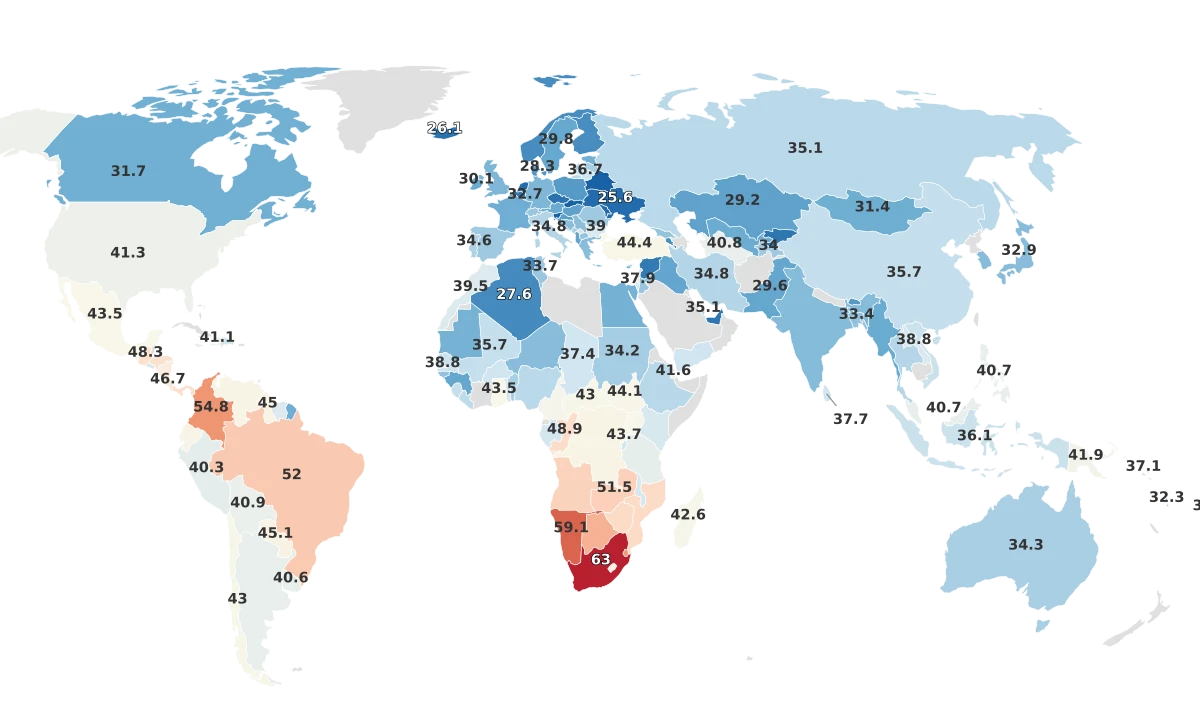
Average Male Height 2019Question Mark
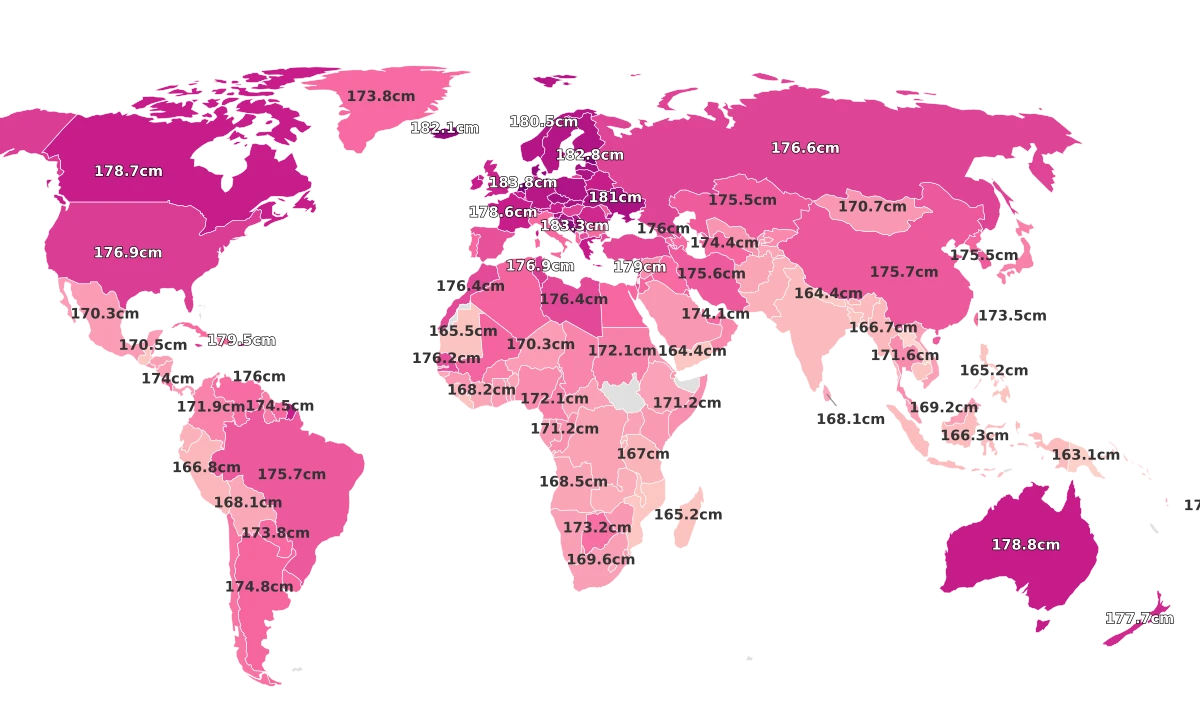
Map visualization
160.1 cm183.8 cm
1
NetherlandsNetherlands
183.8cm
2
MontenegroMontenegro
183.3cm
3
EstoniaEstonia
182.8cm
4
Bosnia and HerzegovinaBosnia and Herzegovina
182.5cm
5
IcelandIceland
182.1cm
6
DenmarkDenmark
181.9cm
7
LatviaLatvia
181.2cm
7
Czech RepublicCzech Republic
181.2cm
9
SlovakiaSlovakia
181cm
9
SloveniaSlovenia
181cm
9
UkraineUkraine
181cm
12
CroatiaCroatia
180.8cm
13
SerbiaSerbia
180.7cm
13
LithuaniaLithuania
180.7cm
13
PolandPoland
180.7cm
16
FinlandFinland
180.6cm
17
SwedenSweden
180.5cm
17
NorwayNorway
180.5cm
19
GermanyGermany
180.3cm
20
DominicaDominica
180.2cm
21
BermudaBermuda
179.7cm
22
Puerto RicoPuerto Rico
179.5cm
23
GreeceGreece
179.3cm
24
BelgiumBelgium
179.1cm
25
LebanonLebanon
179cm
25
IrelandIreland
179cm
27
AndorraAndorra
178.8cm
27
Antigua and BarbudaAntigua and Barbuda
178.8cm
27
AustraliaAustralia
178.8cm
30
CanadaCanada
178.7cm
30
SwitzerlandSwitzerland
178.7cm
30
BelarusBelarus
178.7cm
30
GrenadaGrenada
178.7cm
34
FranceFrance
178.6cm
35
AustriaAustria
178.5cm
35
LuxembourgLuxembourg
178.5cm
37
Cook IslandsCook Islands
178.3cm
37
French PolynesiaFrench Polynesia
178.3cm
39
United KingdomUnited Kingdom
178.2cm
40
RomaniaRomania
177.8cm
41
New ZealandNew Zealand
177.7cm
42
Saint Vincent and the GrenadinesSaint Vincent and the Grenadines
177.5cm
43
NiueNiue
177.2cm
44
American SamoaAmerican Samoa
177.1cm
45
JamaicaJamaica
177cm
45
BarbadosBarbados
177cm
47
TunisiaTunisia
176.9cm
47
United StatesUnited States
176.9cm
49
RussiaRussia
176.6cm
49
HungaryHungary
176.6cm
51
MoroccoMorocco
176.4cm
51
Saint LuciaSaint Lucia
176.4cm
51
TurkeyTurkey
176.4cm
51
LibyaLibya
176.4cm
51
North MacedoniaNorth Macedonia
176.4cm
56
Cape VerdeCape Verde
176.3cm
57
SenegalSenegal
176.2cm
58
SpainSpain
176.1cm
59
Trinidad and TobagoTrinidad and Tobago
176cm
59
IsraelIsrael
176cm
59
GeorgiaGeorgia
176cm
62
SeychellesSeychelles
175.9cm
63
ChinaChina
175.7cm
63
BrazilBrazil
175.7cm
65
MoldovaMoldova
175.6cm
65
IranIran
175.6cm
67
South KoreaSouth Korea
175.5cm
67
KazakhstanKazakhstan
175.5cm
69
TongaTonga
175.1cm
70
MaliMali
175cm
70
KuwaitKuwait
175cm
70
AlgeriaAlgeria
175cm
70
PalestinePalestine
175cm
74
ArgentinaArgentina
174.8cm
74
Hong KongHong Kong
174.8cm
74
JordanJordan
174.8cm
77
North KoreaNorth Korea
174.7cm
78
EgyptEgypt
174.6cm
78
Dominican RepublicDominican Republic
174.6cm
80
SurinameSuriname
174.5cm
81
BahamasBahamas
174.4cm
81
PortugalPortugal
174.4cm
81
MaltaMalta
174.4cm
81
SamoaSamoa
174.4cm
81
ItalyItaly
174.4cm
81
TurkmenistanTurkmenistan
174.4cm
87
UruguayUruguay
174.3cm
88
BulgariaBulgaria
174.2cm
89
AlbaniaAlbania
174.1cm
89
United Arab EmiratesUnited Arab Emirates
174.1cm
91
FijiFiji
174cm
91
Costa RicaCosta Rica
174cm
91
AzerbaijanAzerbaijan
174cm
94
IraqIraq
173.8cm
94
ParaguayParaguay
173.8cm
94
GreenlandGreenland
173.8cm
97
Saint Kitts and NevisSaint Kitts and Nevis
173.7cm
97
ArmeniaArmenia
173.7cm
99
CubaCuba
173.6cm
100
SingaporeSingapore
173.5cm
100
VenezuelaVenezuela
173.5cm
100
TaiwanTaiwan
173.5cm
103
QatarQatar
173.3cm
104
BotswanaBotswana
173.2cm
105
MauritiusMauritius
173cm
106
ChileChile
172.9cm
107
BahrainBahrain
172.8cm
108
CyprusCyprus
172.7cm
109
GuyanaGuyana
172.2cm
109
HaitiHaiti
172.2cm
111
SudanSudan
172.1cm
111
CameroonCameroon
172.1cm
111
JapanJapan
172.1cm
114
Burkina FasoBurkina Faso
171.9cm
114
ColombiaColombia
171.9cm
116
ChadChad
171.8cm
117
OmanOman
171.7cm
117
KyrgyzstanKyrgyzstan
171.7cm
119
NigeriaNigeria
171.6cm
119
ThailandThailand
171.6cm
119
SyriaSyria
171.6cm
122
TuvaluTuvalu
171.3cm
123
Republic of the CongoRepublic of the Congo
171.2cm
123
SomaliaSomalia
171.2cm
125
UzbekistanUzbekistan
170.9cm
126
DjiboutiDjibouti
170.8cm
127
El SalvadorEl Salvador
170.7cm
127
ZimbabweZimbabwe
170.7cm
127
Saudi ArabiaSaudi Arabia
170.7cm
127
GuineaGuinea
170.7cm
127
MongoliaMongolia
170.7cm
132
EritreaEritrea
170.6cm
132
PalauPalau
170.6cm
134
KenyaKenya
170.5cm
134
GabonGabon
170.5cm
134
BelizeBelize
170.5cm
137
Sao Tome and PrincipeSao Tome and Principe
170.4cm
138
MexicoMexico
170.3cm
138
GhanaGhana
170.3cm
138
NigerNiger
170.3cm
141
PanamaPanama
170.2cm
142
KiribatiKiribati
170.1cm
142
TogoTogo
170.1cm
144
NicaraguaNicaragua
169.9cm
145
NamibiaNamibia
169.7cm
146
MicronesiaMicronesia
169.6cm
146
South AfricaSouth Africa
169.6cm
146
HondurasHonduras
169.6cm
146
NauruNauru
169.6cm
150
EswatiniEswatini
169.4cm
151
MalaysiaMalaysia
169.2cm
152
Central African RepublicCentral African Republic
169cm
153
VietnamVietnam
168.9cm
154
EthiopiaEthiopia
168.8cm
155
UgandaUganda
168.7cm
156
DR CongoDR Congo
168.6cm
157
AfghanistanAfghanistan
168.5cm
157
AngolaAngola
168.5cm
159
BeninBenin
168.4cm
159
GambiaGambia
168.4cm
159
TajikistanTajikistan
168.4cm
162
VanuatuVanuatu
168.3cm
163
Guinea BissauGuinea Bissau
168.2cm
163
Ivory CoastIvory Coast
168.2cm
163
Equatorial GuineaEquatorial Guinea
168.2cm
166
Sri LankaSri Lanka
168.1cm
166
BoliviaBolivia
168.1cm
168
MaldivesMaldives
167.9cm
168
LesothoLesotho
167.9cm
170
ComorosComoros
167.7cm
171
ZambiaZambia
167.6cm
172
PakistanPakistan
167.3cm
172
EcuadorEcuador
167.3cm
172
BurundiBurundi
167.3cm
175
BhutanBhutan
167cm
175
TanzaniaTanzania
167cm
177
PeruPeru
166.8cm
178
MyanmarMyanmar
166.7cm
179
IndiaIndia
166.5cm
180
Sierra LeoneSierra Leone
166.4cm
181
BruneiBrunei
166.3cm
181
IndonesiaIndonesia
166.3cm
183
RwandaRwanda
166cm
184
MalawiMalawi
165.7cm
185
LiberiaLiberia
165.5cm
185
MauritaniaMauritania
165.5cm
187
Marshall IslandsMarshall Islands
165.3cm
187
CambodiaCambodia
165.3cm
189
MadagascarMadagascar
165.2cm
189
PhilippinesPhilippines
165.2cm
191
BangladeshBangladesh
165.1cm
192
YemenYemen
164.4cm
192
NepalNepal
164.4cm
192
GuatemalaGuatemala
164.4cm
195
MozambiqueMozambique
164.3cm
196
Solomon IslandsSolomon Islands
163.1cm
196
Papua New GuineaPapua New Guinea
163.1cm
198
LaosLaos
162.8cm
199
Timor LesteTimor Leste
160.1cm
Average Height By Country
Share

Last updated March 28, 2026

The Gap Between Tallest and Shortest Is Nearly a Foot

The numbers in this ranking come from one of the largest human growth studies ever conducted. Published in The Lancet in 2020, the NCD Risk Factor Collaboration pooled 2,181 population-based studies covering 65 million participants across 200 countries and territories from 1985 to 2019. The heights represent average 19-year-olds, the age by which most people have reached their full adult stature.

Netherlands leads the world at 183.8 cm for males, roughly six feet tall. Timor Leste sits at the other end at 160.1 cm, about 5 feet 3 inches. The gap between them is 23.7 centimeters, close to the length of a standard ruler.

For women, the spread is nearly as wide. The Netherlands tops the female rankings at 170.4 cm. Guatemala anchors the bottom at 150.9 cm, a difference of 19.5 centimeters.

The distribution is remarkably even. The global mean for males is 173.1 cm and the median is 173.5 cm, meaning there is no dramatic skew toward the top or bottom. Most countries cluster within a few centimeters of the middle. The outliers sit at both extremes: Northern and Southeastern Europe dominate the top tier, while South Asia, Southeast Asia, and parts of Central America anchor the bottom.

All Metrics

Region ↕Male Height 2019↕Female Height 2019↕
Netherlands
Montenegro
Estonia
Bosnia and Herzegovina
Iceland
Denmark
Latvia
Czech Republic
Slovakia
Slovenia
Ukraine
Croatia
Serbia
Lithuania
Poland
Finland
Sweden
Norway
Germany
Dominica
Bermuda
Puerto Rico
Greece
Belgium
Lebanon
Ireland
Andorra
Antigua and Barbuda
Australia
Canada
Switzerland
Belarus
Grenada
France
Austria
Luxembourg
Cook Islands
French Polynesia
United Kingdom
Romania
New Zealand
Saint Vincent and the Grenadines
Niue
American Samoa
Jamaica
Barbados
Tunisia
United States
Russia
Hungary
Morocco
Saint Lucia
Turkey
Libya
North Macedonia
Cape Verde
Senegal
Spain
Trinidad and Tobago
Israel
Georgia
Seychelles
China
Brazil
Moldova
Iran
South Korea
Kazakhstan
Tonga
Mali
Kuwait
Algeria
Palestine
Argentina
Hong Kong
Jordan
North Korea
Egypt
Dominican Republic
Suriname
Bahamas
Portugal
Malta
Samoa
Italy
Turkmenistan
Uruguay
Bulgaria
Albania
United Arab Emirates
Fiji
Costa Rica
Azerbaijan
Iraq
Paraguay
Greenland
Saint Kitts and Nevis
Armenia
Cuba
Singapore
Venezuela
Taiwan
Qatar
Botswana
Mauritius
Chile
Bahrain
Cyprus
Guyana
Haiti
Sudan
Cameroon
Japan
Burkina Faso
Colombia
Chad
Oman
Kyrgyzstan
Nigeria
Thailand
Syria
Tuvalu
Republic of the Congo
Somalia
Uzbekistan
Djibouti
El Salvador
Zimbabwe
Saudi Arabia
Guinea
Mongolia
Eritrea
Palau
Kenya
Gabon
Belize
Sao Tome and Principe
Mexico
Ghana
Niger
Panama
Kiribati
Togo
Nicaragua
Namibia
Micronesia
South Africa
Honduras
Nauru
Eswatini
Malaysia
Central African Republic
Vietnam
Ethiopia
Uganda
DR Congo
Afghanistan
Angola
Benin
Gambia
Tajikistan
Vanuatu
Guinea Bissau
Ivory Coast
Equatorial Guinea
Sri Lanka
Bolivia
Maldives
Lesotho
Comoros
Zambia
Pakistan
Ecuador
Burundi
Bhutan
Tanzania
Peru
Myanmar
India
Sierra Leone
Brunei
Indonesia
Rwanda
Malawi
Liberia
Mauritania
Marshall Islands
Cambodia
Madagascar
Philippines
Bangladesh
Yemen
Nepal
Guatemala
Mozambique
Solomon Islands
Papua New Guinea
Laos
Timor Leste

Why the Dutch Grew Taller Than Everyone Else

The Dutch were not always the tallest people in the world. In the 18th century, the average Dutchman was relatively short by European standards. The transformation happened over roughly 150 years, and it tracks with three reinforcing forces: nutrition, healthcare, and an unusual twist of natural selection.

The Netherlands has one of the highest per-capita dairy consumption rates in the world. Milk, cheese, and yogurt are dietary staples, and they deliver exactly what growing bones need: calcium and protein. That dietary foundation sits on top of a comprehensive welfare state that has provided universal healthcare, strong maternal care, and childhood nutrition programs since the mid-20th century. Dutch children rarely face the chronic infections and nutritional deficits that stunt growth elsewhere.

A widely cited study from the London School of Hygiene & Tropical Medicine found evidence that natural selection may also be at work. Taller Dutch men, on average, had more surviving children than shorter men over several generations. That reproductive advantage meant taller genes were passed on at higher rates than in populations where height conferred no fertility benefit. The researchers noted this pattern was stronger in the Netherlands than in other countries studied.

Montenegro (183.3 cm) sits just half a centimeter behind the Netherlands, and the Balkans as a region punch well above their economic weight. Bosnia and Herzegovina (182.5 cm), Croatia (180.8 cm), and Serbia (180.7 cm) all land in the top 15 despite having far smaller economies than Western Europe.

Northern Europe fills out the rest of the top tier. Estonia (182.8 cm), Iceland (182.1 cm), and Denmark (181.9 cm) sit within two centimeters of the Dutch. The common thread across these populations is not wealth. It is that they have had access to adequate protein and healthcare during the critical childhood growth window for at least two to three generations.

Malnutrition Writes the Bottom of the Rankings

The bottom of this ranking is not a genetic map. It is a nutrition map. Timor Leste (160.1 cm for males) sits farther below the global mean than any other country, more than 13 cm shorter than the average. Laos (162.8 cm), Papua New Guinea (163.1 cm), and Solomon Islands (163.1 cm) cluster just above it. The shared driver across these countries is chronic childhood malnutrition and stunting, defined by the World Health Organization as a height-for-age measurement more than two standard deviations below the growth reference median.

The starkest case is Guatemala, which anchors the very bottom of the female rankings at 150.9 cm. According to the World Bank and UNICEF, nearly half of all Guatemalan children under five suffer from chronic malnutrition. In rural indigenous Mayan communities, that figure climbs to 70 to 80 percent. These children do not lack the genetic potential to grow taller. They lack the calories, protein, clean water, and healthcare to reach it.

The most decisive evidence comes from biological anthropologist Barry Bogin, whose research tracked Guatemalan Mayan families who migrated to the United States. Their children, raised with better nutrition and sanitation, grew several inches taller than peers who remained in Guatemala. The genes were the same. The environment was not.

In South Asia, the pattern repeats. Bangladesh averages 165.1 cm for males. Nepal is close behind at 164.4 cm. India, the region's largest country, averages 166.5 cm. All three fall well below the global mean. These countries share high rates of childhood undernutrition and limited access to animal-source protein during the critical first 1,000 days of life, from conception through age two.

South Korea Proves Height Is Not Fixed

If average height were primarily determined by genetics, population rankings would barely change over time. They have changed dramatically. The most striking example is South Korea. A landmark study published in eLife found that South Korean women gained approximately 20.2 centimeters in average height between 1914 and 2014, the largest increase recorded for any population in the world over that period.

South Korean males in this dataset average 175.5 cm, placing the country in the middle of the pack globally but well above most of East Asia. A century ago, Koreans were among the shortest populations in their region. The transformation tracks almost exactly with the country's economic rise from one of the world's poorest nations after the Korean War to a high-income economy, bringing with it better food, cleaner water, and modern healthcare.

The contrast with North Korea is instructive. North Korean males average 174.7 cm, just 0.8 cm shorter than their southern neighbors. The populations share a common genetic ancestry, but decades of economic divergence have begun to separate them. The gap is modest so far, but ongoing nutritional deficits in North Korea suggest it may widen in future measurements.

Japan (172.1 cm) tells a related but different story. Japanese heights surged after World War II as the economy boomed and diets shifted toward greater protein intake. But that growth has largely plateaued since the 1990s, and Japanese males now sit below both South Korea and China (175.7 cm). China's average has climbed rapidly as economic development reached rural populations, and Chinese 19-year-olds are now taller than the global mean. None of these rankings are permanent. They are snapshots of how well each country is feeding and caring for its children right now.

Sources & Notes

Keep reading

Additional Rankings

Countries By Population
Demographics
Countries

Countries By Population

Oldest Countries
Demographics
Countries

Oldest Countries

Breast Size By Country
Demographics
Countries

Breast Size By Country

Gini Coefficient By Country
Demographics
Countries

Gini Coefficient By Country

Percentage Of Redheads By Country
Demographics
Countries

Percentage Of Redheads By Country

Countries By Sex Ratio
Demographics
Countries

Countries By Sex Ratio